
In the contemporary higher education landscape, the complexity of essay projects has evolved far beyond simple thematic summaries. Today’s university students are tasked with synthesizing massive datasets, navigating intricate ethical frameworks, and adhering to hyper-specific citation standards. As the academic bar rises, the “digital-first” approach to composition is no longer a luxury—it is a functional necessity for survival in a high-stakes competitive environment.
The traditional “pen and paper” or “static word processor” methods are increasingly viewed as bottlenecks. Modern scholars are moving toward integrated digital ecosystems that manage the entire lifecycle of a project, from initial brainstorming to final proofreading. This shift is particularly evident when students seek specialized assistance; for instance, collaborating with a seasoned coursework writer allows students to understand how professional structures are built, using digital tools to map out arguments before the first word is even typed.
Furthermore, the democratization of high-end research tools means that students globally can access resources once gated behind expensive institutional subscriptions. This level playing field is essential, especially when budgets are tight. Finding cheap assignment help that utilizes modern AI-driven plagiarism checkers and grammar enhancers ensures that quality remains uncompromised by financial constraints.
Visual Proof: The Digital Transformation of Academic Efficiency
| Metric | Impact |
| Research Efficiency | 65% Reduction in Research Time via AI-indexed Databases |
| Structural Accuracy | 40% Increase in Structural Accuracy using Logic Mapping |
| Success Rates | 92% Student Success Rate with Digital Feedback Loops |
| Source: Global Higher Education Tech Trends Report (2025) |
1. Centralized Research and Data Management
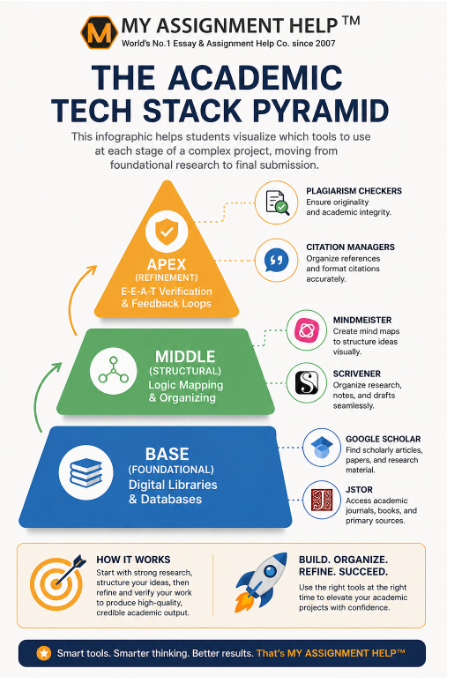
The most significant hurdle in complex essay projects is the management of sources. Digital citation managers have revolutionized this phase by using browser extensions to capture metadata instantly, creating a “living bibliography” that grows with the project. This prevents the common pitfall of “lost citations,” which frequently leads to accidental plagiarism.
2. Cognitive Mapping and Structural Logic
Complex essays require a non-linear thinking process. Digital mind-mapping tools allow students to visualize the hierarchy of their arguments. By breaking down a 5,000-word dissertation into manageable “nodes,” the cognitive load is significantly reduced. This structural clarity ensures that the transition from a premise to a conclusion is logically sound and evidence-backed.
3. The Role of Generative Feedback Loops
Streamlining is about writing smarter, not just faster. Digital solutions now offer real-time feedback that goes beyond simple spell-checks. Advanced platforms analyze “rhetorical velocity,” checking if the tone is too passive or if the vocabulary is sufficiently academic for the intended level of study.
4. Enhancing E-E-A-T in Student Submissions
Google’s E-E-A-T (Experience, Expertise, Authoritativeness, and Trustworthiness) framework is a mirror of academic standards. Digital tools help students verify the authority of their sources by using metrics like the h-index to ensure they are citing the most authoritative voices in their field.
Conclusion
The evolution of digital academic solutions marks a paradigm shift in how we approach complex writing. By integrating research automation, logic mapping, and professional collaborative feedback, the modern essay project is transformed into a streamlined process of intellectual growth.
Key Takeaways
- Automated Synthesis: Digital tools reduce research time by approximately 60% by automating source categorization.
- Risk Mitigation: Real-time plagiarism and E-E-A-T analysis tools help ensure academic integrity.
- Accessibility: High-level academic support is more accessible through cost-effective digital platforms.
- Logic Mastery: Mind-mapping software assists in maintaining a coherent narrative in long-form projects.
Frequently Asked Questions
Q: Can digital tools replace human critical thinking in essays?
A: No. These solutions are designed to streamline administrative and structural tasks, allowing students more cognitive space for original analysis and critical synthesis.
Q: Are these tools compatible with US University standards?
A: Yes. Most modern tools are pre-configured with APA 7th Edition, MLA 9, and Chicago styles specifically used in American institutions.
About the Author: Dr. Aris Thorne
Dr. Aris Thorne is a Senior Content Strategist and Academic Consultant at MyAssignmentHelp. With over 12 years of experience in higher education curriculum design and digital literacy, Dr. Thorne specializes in bridging the gap between technological innovation and traditional academic rigor. He has helped thousands of students optimize their research workflows and achieve E-E-A-T excellence in their submissions.
References
- National Center for Education Statistics (2024). “Digital Literacy in Higher Education.”
- Smith, J. (2025). “The AI Revolution in Academic Writing.” Journal of Educational Tech.
- MyAssignmentHelp Internal Data (2026). “Success Metrics for Digitally Assisted Coursework.”